
Maintenance & Inspection · practical Corolla guide
Toyota Corolla Parking Brake Cable Inspection and Maintenance
A weak or dragging parking brake may come from cable corrosion, incorrect adjustment, lever hardware or the brake mechanism at the wheel. Inspect the complete system rather than tightening the cable first.
Quick answer
What to do first
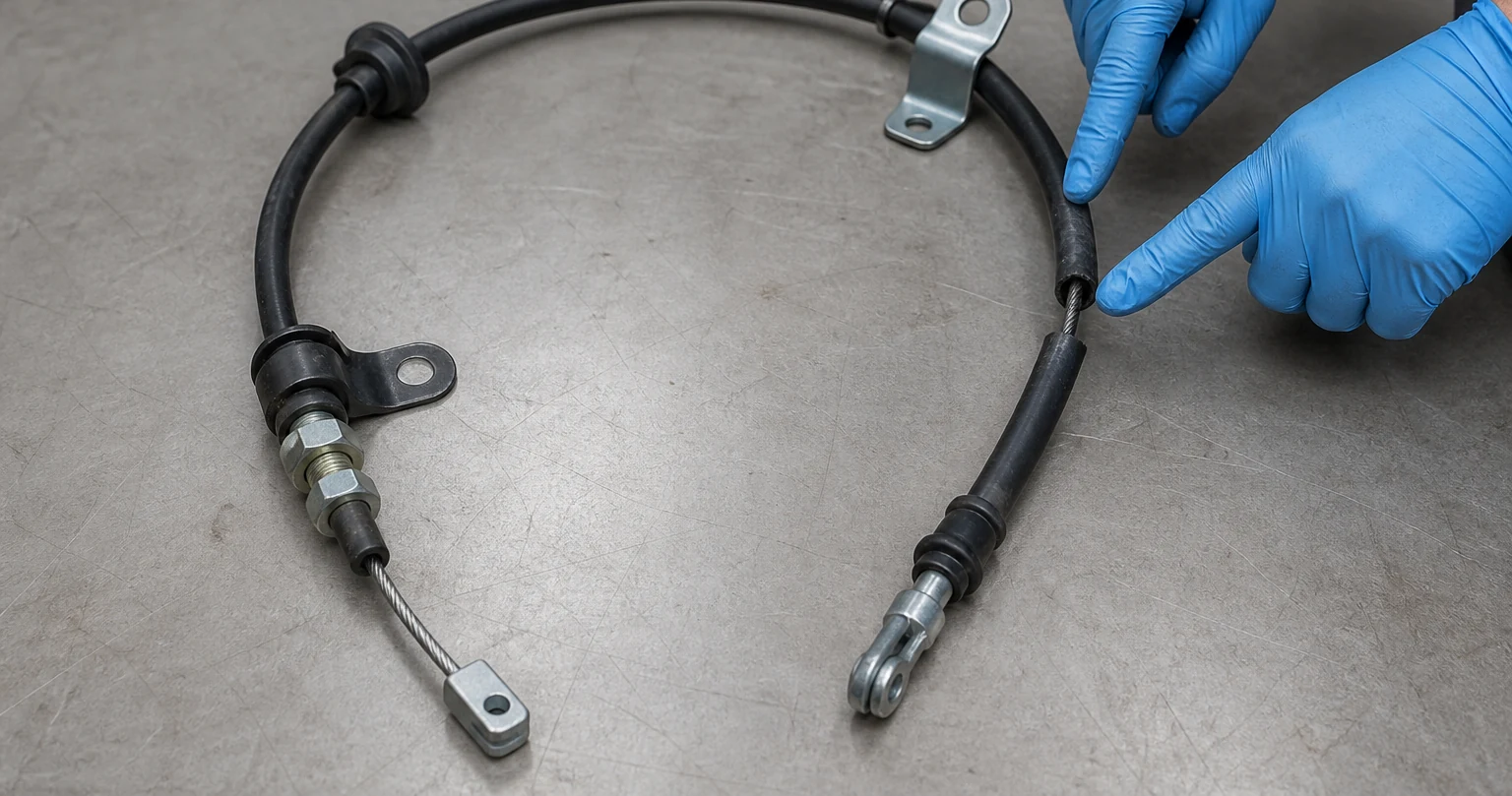
Check lever travel, cable return, outer sheath damage and equal operation at both rear wheels before deciding which cable section is faulty.
01 · Observe the condition
Signs that justify a closer inspection
One sign rarely identifies one failed part. Record when it occurs, compare both sides or cylinders where applicable, and preserve diagnostic evidence before clearing or replacing anything.
Parking brake requires excessive lever or pedal travel
Use this as an observation to investigate, not as automatic proof that the related component has failed.
One rear wheel releases slowly or remains hot
Use this as an observation to investigate, not as automatic proof that the related component has failed.
Cable sheath is split, swollen or heavily corroded
Use this as an observation to investigate, not as automatic proof that the related component has failed.
Vehicle does not hold consistently on an incline
Use this as an observation to investigate, not as automatic proof that the related component has failed.
02 · Separate similar faults
Evidence to collect before choosing a part
| Check | Record | Why it matters |
|---|---|---|
| Cable section | Identify front/intermediate and left/right rear sections | A system can use more than one cable |
| End fittings | Compare clevis, barrel, threaded end and brackets | Length alone cannot identify the cable |
| Brake design | Record rear disc, drum or drum-in-hat arrangement | The wheel-end connection follows the brake design |
| Routing | Photograph brackets, grommets and heat shielding | Correct routing protects movement and cable life |
03 · Practical sequence
A safer inspection order
Prepare and document
Secure the vehicle independently before testing a parking brake.
Inspect the complete system
Observe whether both wheel-end levers return fully after release.
Verify the evidence
Inspect sheath, clips, adjusters and exposed cable without forcing a seized mechanism.
Match the service scope
Record overall layout and both end fittings before requesting the correct section.
04 · Prepare the inspection
What to have ready before touching the part
Good evidence prevents a symptom check from turning into guesswork. Work on a cool, stable vehicle where appropriate and keep the observations tied to the exact Corolla in front of you.
Vehicle record
Write down production year or date, chassis or model code, engine or hybrid designation and destination market. Keep any stored diagnostic codes or dashboard messages exactly as observed.
Part record
Photograph the installed position, connector or mounting details, readable markings and the surrounding components. For this check, pay particular attention to identify front/intermediate and left/right rear sections.
Safe comparison
Use the opposite side, another cylinder or a known-good operating condition only when the comparison is mechanically valid. Length alone cannot identify the cable.
05 · Interpret the findings
Turn observations into a defensible next step
The aim is to confirm a pattern, rule out credible look-alike faults and preserve enough evidence for service or part identification.
Cable section
Record: Identify front/intermediate and left/right rear sections. Reason: A system can use more than one cable. Compare that evidence with the reported condition “Parking brake requires excessive lever or pedal travel” instead of treating either observation as proof on its own.
End fittings
Record: Compare clevis, barrel, threaded end and brackets. Reason: Length alone cannot identify the cable. Compare that evidence with the reported condition “One rear wheel releases slowly or remains hot” instead of treating either observation as proof on its own.
Brake design
Record: Record rear disc, drum or drum-in-hat arrangement. Reason: The wheel-end connection follows the brake design. Compare that evidence with the reported condition “Cable sheath is split, swollen or heavily corroded” instead of treating either observation as proof on its own.
Routing
Record: Photograph brackets, grommets and heat shielding. Reason: Correct routing protects movement and cable life. Compare that evidence with the reported condition “Vehicle does not hold consistently on an incline” instead of treating either observation as proof on its own.
06 · Avoid false conclusions
Common mistakes during diagnosis or replacement planning
Replacing from one symptom
Parking brake requires excessive lever or pedal travel can justify inspection, but it cannot isolate the cause by itself. Confirm the related system and look for the other recorded signs before purchasing a component.
Matching by appearance
Parking-brake cable lengths and ends vary with body, wheelbase, rear brake design and market. Treat every cable section as a separate order line. Similar shape, plug style or overall dimensions should be treated as supporting evidence, never as the complete application decision.
Skipping the cause of wear
When a removed part is damaged, ask what produced the damage. A new component may fail again if contamination, wiring, mounting, lubrication, heat or an adjacent mechanical fault remains unresolved.
07 · Application boundary
Corolla name and year are not enough
Parking-brake cable lengths and ends vary with body, wheelbase, rear brake design and market. Treat every cable section as a separate order line.
For a parts inquiry, record the generation or production date, market, engine or hybrid designation, side or position, old-part reference, connector or mounting evidence and the required quantity. A public reference is an identification lead only and never universal fitment proof.
08 · Verify the outcome
Checks to make after service or before ordering
Confirm the evidence
Inspect sheath, clips, adjusters and exposed cable without forcing a seized mechanism. Keep the measurement, scan record or comparison result with the vehicle notes so the decision can be reviewed later.
Confirm the component scope
Record overall layout and both end fittings before requesting the correct section. Make sure seals, clips, brackets, hardware or paired axle components are stated separately rather than assumed.
Confirm normal operation
After qualified service, check that the original symptom is gone, no new warning or leak is present and the related system behaves consistently. Stop and recheck if the condition returns or safety changes.
10 · Common questions
Before replacing or ordering the part
Should a tight parking brake simply be adjusted?
Not until binding, corrosion and wheel-end mechanism condition have been checked. Adjustment cannot repair a damaged cable.
Can one rear cable be replaced?
The failed section can be identified separately, but both sides should be inspected for comparable age and corrosion.
Is cable length enough for ordering?
No. End fittings, brackets, sheath stops, routing and brake design also matter.
Safety and application note
Use these checks as general inspection and part-identification guidance. Corolla generations, engines, hybrid systems, body variants and markets differ, so follow the service information applicable to the exact vehicle and seek qualified help whenever the task involves safety systems, pressurized fluid, high current, stored energy or uncertain diagnosis.
Continue with more maintenance & inspection guides, or return to the complete Corolla maintenance and parts guide library.