
Application boundary
HVAC case, refrigerant and pipe orientation must be resolved before a proposed part is treated as relevant.
Corolla air conditioning · procurement guide
Identify the HVAC case and refrigerant branch, then compare the core dimensions, tube geometry, sensor pocket and sealing foam.
Quote definition
This page does not publish a universal OE number. It converts the buyer task into vehicle, part, commercial and packing evidence that can be checked in writing.
HVAC case, refrigerant and pipe orientation must be resolved before a proposed part is treated as relevant.
Record core dimensions, inlet/outlet geometry, sensor pocket and foam seals; connector or mounting similarity alone is not enough.
Write the request as core only or core with valve, sensor and sealing foam, with included hardware and seals stated separately.
Seal ports from moisture and protect pipe geometry from carton pressure.
Scoped OE evidence
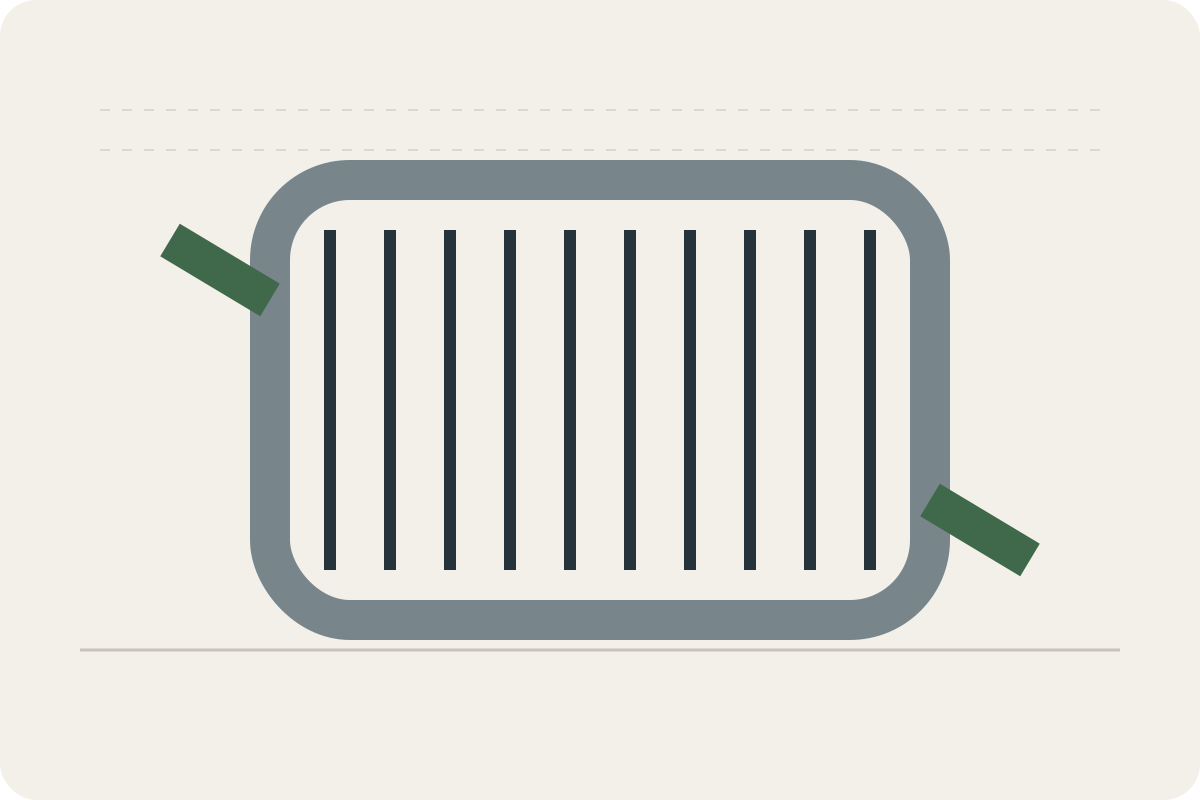
Cooler evaporator sub-assembly. Public catalog evidence lists this evaporator for selected 2009–2019 Corolla 1.8L and 2.4L applications.
Public catalog evidence lists this evaporator for selected 2009–2019 Corolla 1.8L and 2.4L applications. This is an identification lead, not universal Corolla fitment.
Review the public catalog record (accessed 2 August 2026). POPXA does not claim stock, genuine supply, every-market fitment or a complete supersession chain.
Decision record
| Decision point | Evidence to send |
|---|---|
| Vehicle branch | Record the Corolla generation, chassis/model code, production month, body style and destination market before comparing evaporator cores. |
| System application | Confirm HVAC case, refrigerant and pipe orientation; a sales name or nominal model year does not resolve this branch. |
| Physical interface | Compare core dimensions, inlet/outlet geometry, sensor pocket and foam seals, using clear installed and removed-part photos wherever possible. |
| Requested assembly | State whether the line covers core only or core with valve, sensor and sealing foam; reconcile every supplier photo with a written contents list. |
| Commercial basis | Give quantity per SKU, trial or repeat demand, destination port, preferred Incoterm and any inspection-document requirement. |
| Packing control | Seal ports from moisture and protect pipe geometry from carton pressure. |
Part-specific risk
For Corolla evaporator cores, the controlling difference can be core dimensions, inlet/outlet geometry, sensor pocket and foam seals. Keep every proposed part tied to the vehicle record and installed component; a broad year-range cross reference is not approval evidence.
Parent and sibling routes
Return to the complete system directory and identification guidance.
Open directory →Resolve generation, body, powertrain, production and market evidence before part matching.
Check the vehicle →Review HVAC case, driving side and speed-control design and the required physical evidence.
View guide →Review refrigerant, evaporator connection and valve block design and the required physical evidence.
View guide →Buyer FAQ
Start with generation, chassis/model code and production month, then resolve HVAC case, refrigerant and pipe orientation. That branch is more useful than model year alone.
Photograph the installed position, label and mounting or connector faces, then record core dimensions, inlet/outlet geometry, sensor pocket and foam seals. Keep every measurement tied to the same removed component.
State core only or core with valve, sensor and sealing foam. List seals, brackets, motors, modules, hardware or paired sides separately so quotations can be compared on the same contents.
Seal ports from moisture and protect pipe geometry from carton pressure.
No. It is a scoped public catalog example. Confirm the VIN or chassis/model code, production date and installed component before quotation.
Corolla parts RFQ
Include the generation or year, engine or hybrid version, OE/reference numbers, quantities, destination and packing request. Attach a spreadsheet or old-part photos when useful.